Showing posts with label Angles. Show all posts

Wednesday, July 23, 2014

Geometry Angles Post 10

Three Dimensional Shapes
It is a real talent to see/draw 3D shapes on a flat piece of paper. 
This years course is about your ability to name the main 3D shapes.

Here are the main types of 3D shapes that we can name the most common shapes.

The shapes in order are...
  1. Sphere (note a half a sphere is called a 'hemisphere').
  2. Pyramid (note this is a triangle based pyramid).
  3. Cuboid (it is mathematically incorrect to say 'box').
  4. Cylinder
  5. Cube
  6. Cone.


Tuesday, July 22, 2014

Geometry Angles Post 9

Angles on Parallel Lines
Parallel lines are lines that never cross because they are travelling in the same direction.  We use
arrows on the lines to represent parallel lines. 

railway lines never touch

Perpendicular lines cross at 90 degrees (not needed but interesting).

Parallel lines are particularly good at creating interesting math problems especially when they combine with our previous geometry rules (angles inside triangles, angles at a point, angles on a straight line or vertically opposite angles are equal). 


parallel lines

The main ways that angles can form on parallel lines is if we have a line that crosses over the parallel lines (a transversal).  Then we can form the three main types of angles on parallel lines...
  1. Corresponding Angles (are equal),
  2. Co-interior Angles (add to 180), and,
  3. Alternative Angles (are equal).
Builders and architects especially need to be good with angles on parallel lines...


See all the parallel lines.
 

The work for angles on straight lines can be found on pages 253 - 272 Exercises 18.1 to 18.7. 


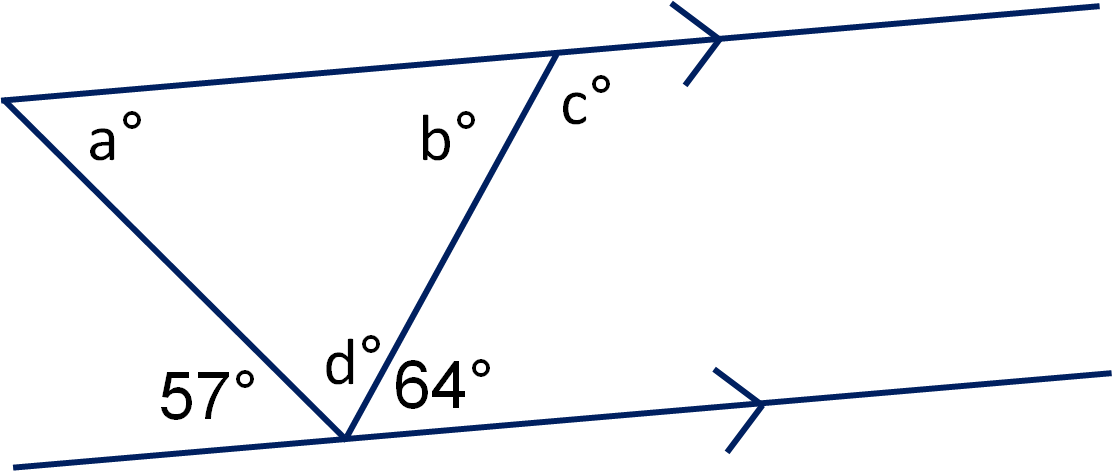
Can you see how each of the angles a, b, c, and d can be calculated using our geometry rules?  

Geometry Angles Checklist

Summary of Learning
These are the things that we've learnt thus far...
  1. Names of Polygons (triangles, quadrilaterals, pentagon, hexagon, heptagon, octagon, nonagon and decagon).
  2. Names of Triangles (right angle, equilateral, isosceles, and scalene).
  3. Names of Angles (acute, right, obtuse and reflex).
  4. Angles at a Point (add to 360).
  5. Vertically Opposite Angles (are equal).
  6. Angles on a Straight Line (add to 180).
  7. Interior Angles on a Triangle (add to 180).

These are the things left to learn...
  1. Names of Parts of Circles.
  2. Names of 3d Shapes.
  3. Angles on Parallel Lines.

This means that we can start to prep up for an assessment (mini topic means smaller test) next week.


Monday, July 21, 2014

Geometry Angles Post 7

Angles Inside a Triangle
This is a common test type problem (you will definitely have to memorise this).  The gist of it is that all of the three corners of any triangle (remember that there are three types Equilateral, Isosceles, Right Angle and Scalene) you can form a straight line post #3.

Here is a physical proof of the idea that corners of triangles make straight lines...

The rule that we need is "Interior Angles of a Triangle sum to 180 degrees" (I'll accept inside angles of a triangle add to 180)

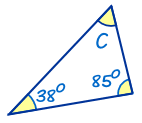
For Achieve you will need to be able to find the value of one corner (remember not drawn to scale)... problems like...
We can calculate the value of the missing corner (angle C).  We know all three must add up to 180.  So we use our calculator and put in...

                        180 - 38 - 85 = 57 (remember to use degree symbol)


These type of problems can be found on page 226 Exercise 14.13. 

Tuesday, July 1, 2014

Geometry Angles Post 6

Angles at a Point
This is very important idea/rule in angle geometry.  It is very similar concept to angles on a straight line.  The idea is that in a full spin you have 360degrees (remember in tests to use the symbol).  


The way we find the solution is to take all the other numbers off (subtraction) 360 degrees. 


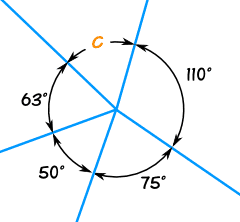
In this example you would type into your calculator
          360 - 110 - 75 - 50 - 63 = 62 degrees


In NCEA you get 'achieve' grades for getting the numbers right.  You have to have the degree symbol.  You get a 'merit' grade if you have the right reason.  E.g. 


Achieve to say...

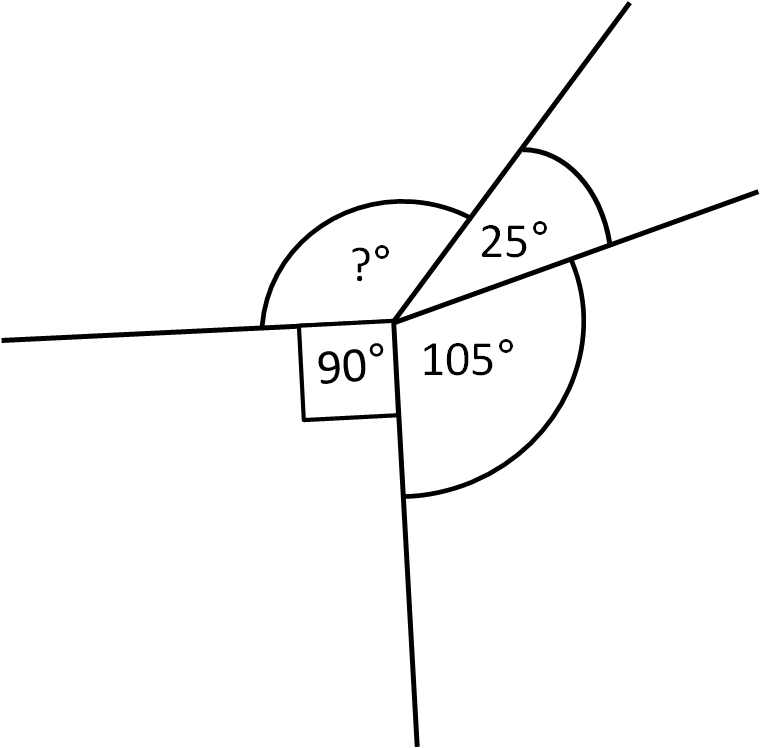
360 - 90 - 105 - 25 = 140 degrees. 


Merit to say...

360 - 90 - 105 - 25 = 140 degrees because angles at a point add to 360 degrees. 


The work for this is Exercise 14.10 on page 221.  Again do answers only for all but five problems (where you can do a sketch).  The sketch is for you future revision. 

Geometry Angles Post 5

Vertically Opposite Angles
These are pretty logical - once you've seen them once you'll be sweet with these.  Because they look as they are.

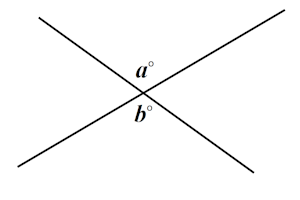
Vertically Opposite Angles - are created when two straight lines cross over.  They are the angle exactly opposite each other. 

Here a and b a vertically opposite angles.  The rule is "vertically opposite angles are equal". 

These problems can be found on page 220 exercise 14.9 - go answers only. 

Geometry Angles Post 3

Three Hundred and Sixty

Many centuries ago the ancient Greeks decided to use the number 360 to represent a full spin.  Skateboarders know all about 360's and 180's.  Now in modern maths we use 360 as our standard.  It is really important that you know about this. 


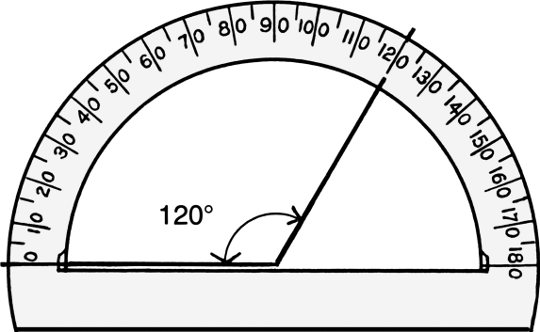
Using A Protractor
This is a compulsory part of your unit - it will be in the test.
You just put the vertex/corner in the middle...


Can you see they have one line on zero?


pages 212-215 have these problems


Angles on a Straight Line
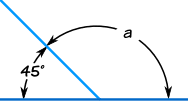
This is our first and most basic geometric rule.  A straight line is technically half a full spin.  The rule is "Angles on a straight line add to 180 degrees" nb this computer doesn't do degree symbol. 

Can you see that these two angles are on a straight line.  The size of a must be 180 minus 45.  So we would write the answer as a=135degrees. 

Exercise 14.7 on page 217 has these problems - there are 15 problems.  Do them all but you only need to draw/sketch five pictures (the rest answers only). 

Monday, June 30, 2014

Geometry Angles Post 2

Types of Angles

For this unit of work we are only interested in shapes that are made with straight lines (and circles).  So we need to learn the basics of what actually makes a shape with straight lines.

The smallest picture on a flat page is called a point (looks like a dot).  Then we have a ray which is a line that goes in one direction from a point.  Then we have a line which goes in both directions.  Then we have a line segment which is part of a line. 

Here is a picture to explain what I mean.

When two lines met they create a vertex (aka a corner).  Then we've got our start of an angle. 


The angle is one of the base ideas of Geometry Mathematics.  It is something that we can have lots of learning on.  You need to know the names of the various types of angles...

Acute angle - little one.  like "a cute baby"

Reflex angle - bent over.  like having your arm twisted. 

Right Angle - 90 degrees. 

Sunday, June 29, 2014

Geometry Angles Post 1

Things You Need to Know

In this topic there are several things/facts/names that you need (memorise).  Most are very common words (like square etc) but some are a little harder to remember. 
 
Here are the first ones (and some tricks to help you recall them)...

                            The Polygons...


The ones people struggle with and ways to remember them...
+ Pentagon (FBI headquarters see below*).
+ Hexagon (hex and six both have x's in them).
+ Heptagon (the French word for seven is sept).
+ Nonagon (nona and nine both have n's in them).


The Types of Triangles...
  • Right Angle - has a 90 degree corner.
  • Isosceles - has two sides the same length.
  • Equalateral - has three sides the same length.
  • Scalene - has no sides the same length.
[you can have mixtures of some of these]


Last Thing - RegularA regular polygon is when all the sides (and angles) are the same.   Here is a picture of three pentagons but only one is regular.  Usually we mark the same lengths with dashes.
Here is a picture of the FBI head quarters "The Pentagon". 


Thursday, June 26, 2014

New Topic Geometry

Geometry

Geometry is a nice topic in maths.  It is all about shapes (and mostly flat two dimensional shapes). 

Geometry is broken down into two major sub units.  Angle Geometry and Transformational Geometry.  Angle Geometry is some of the oldest maths around - much of it is from ancient greeks.  It is about the rules that geometric shapes obey.  I like angle geometry because there is a beauty to it, it is logical and can get pretty complicated.  

Geometry is especially important if you're interested in graphing, design, architecture, engineering, building, painting and other arts. 

Here is my traditional unit plan that I'll use in this class.  It has the what you should already know, what we'll be covering and some extension material...


Here is the one on Geometry Angles (click to see a bigger version). 


The link to the curriculum is that the earlier knowledge is level three, this year's work is mostly level four, and start thinking about is level five. 

At year 11 Angles is worth four credits externally (1.6) and three credits internally (1.8)


There is also Transformational Geometry.  At year 11 Transformations are worth two credits internally (1.9).  We're not doing this for this topic right now.